
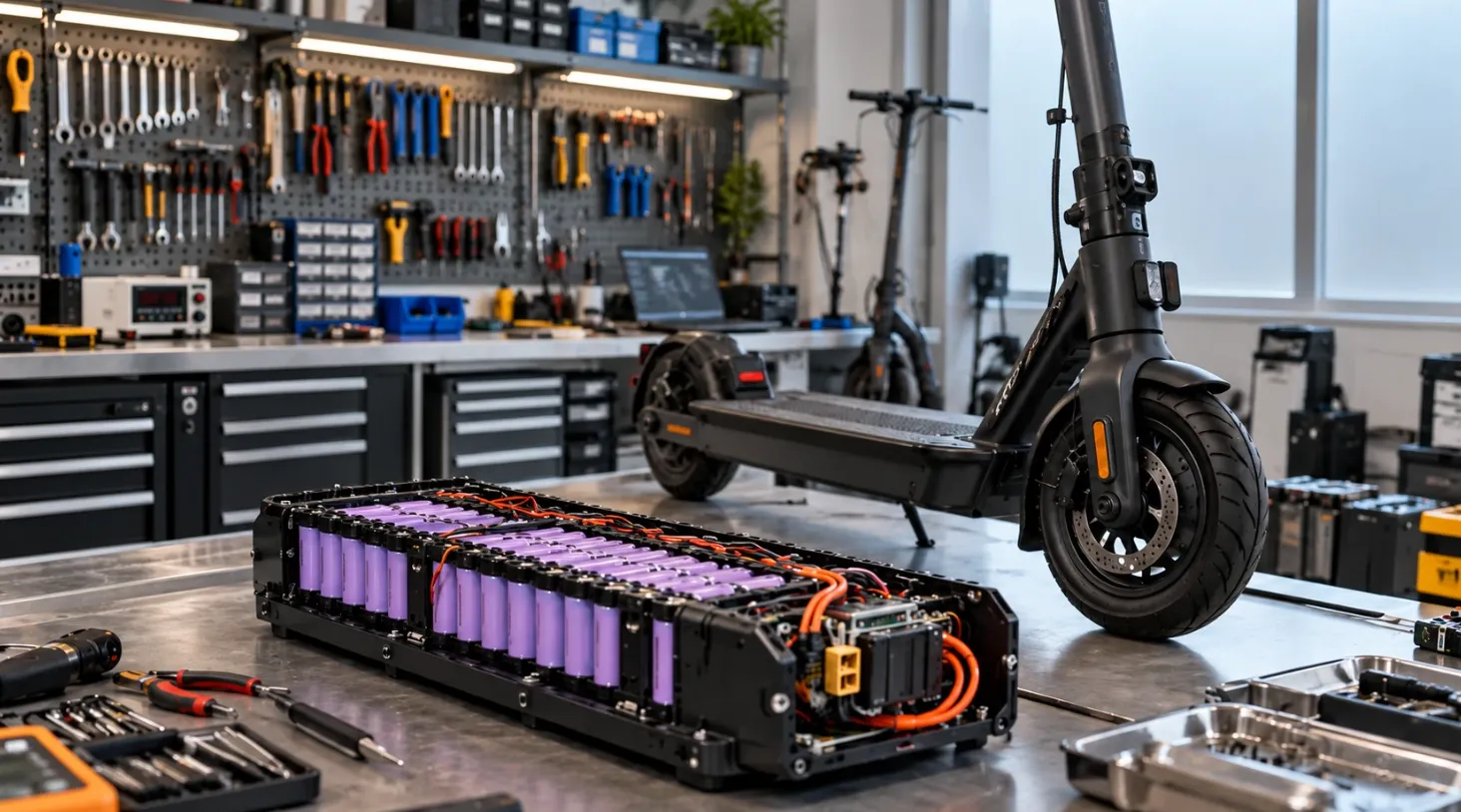
Battery range remains one of the main practical limitations of electric scooters. As vehicles age, the issue becomes more complex: some riders need additional range, while others are dealing with batteries that have already lost part of their original capacity.
In these situations, replacing the original battery with a standard pack is not always the only option. Custom lithium batteries can be designed to increase capacity, replace degraded packs or adapt an electric scooter to specific range requirements.
However, increasing battery capacity is not simply a matter of adding more amp-hours.
Why custom batteries are used
Electric scooters differ significantly in their electrical architecture and available battery space.
A battery project therefore needs to consider several variables, including:
- system voltage;
- condition of the original battery;
- available installation space;
- controller requirements;
- BMS specifications;
- discharge current;
- wiring and connectors;
- charging requirements;
- electronic and firmware restrictions.
Depending on these factors, the appropriate solution may be a higher-capacity internal battery, an external battery or a switched battery system.
Specialised workshops such as AF SCOOTERS in Spain work with custom lithium battery configurations for electric scooters, including 48V, 52V, 60V and 72V projects.
Internal or external battery?
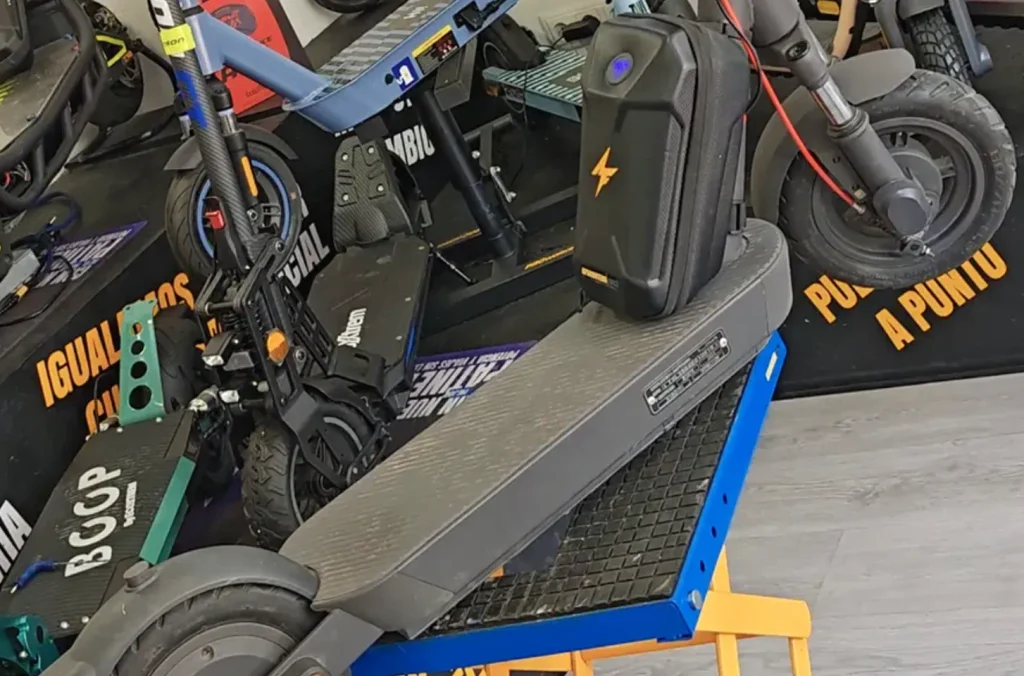
An internal battery has the advantage of remaining integrated into the original structure of the scooter. Its main limitation is physical space: there is only a certain amount of capacity that can be installed inside the original compartment.
An external battery provides another possibility when additional capacity is required but internal space is limited.
This does not mean that an external battery is always the better option.
If the original battery is significantly degraded, its condition should be assessed before adding another battery. In some cases, repairing or replacing the internal pack is technically more appropriate than installing an additional external one.
Compatibility also matters. Voltage, controller characteristics, BMS, wiring and the scooter’s electronic architecture can determine which configurations are possible.
Switched battery systems
Some electric scooters present another challenge.
Their electronics or firmware may make simultaneous operation with an internal and external battery unsuitable. One solution is a switched system in which the scooter operates from the batteries separately rather than using both packs simultaneously.
This approach was used in a real-world range experiment conducted in Spain with a Ninebot MAX G3 E.
The scooter was equipped with a custom 48V 15Ah switched external lithium battery manufactured by AF SCOOTERS.
The objective was straightforward: measure how much distance the external battery could provide under real riding conditions.
A 44.7 km real-world battery test
The nominal external battery was rated at 15Ah, while its calculated typical capacity was approximately 14.4Ah.
During the test, the Ninebot MAX G3 E travelled 44.7 kilometres using the external battery alone.
This corresponds to approximately 3.10 kilometres per amp-hour under the conditions of that original particular experiment.
The result should not be treated as a universal formula.
Electric scooter energy consumption changes according to rider weight, speed, terrain, temperature, tyre pressure, wind, motor efficiency and riding conditions. Two scooters using batteries with the same nominal capacity can therefore achieve different ranges.
The experiment is useful because it provides real-world data that can be compared with theoretical battery calculations.
Battery capacity is only part of the equation
A larger battery does not automatically mean a successful range upgrade.
The battery must also be capable of supplying the current required by the vehicle. The BMS must be appropriate for the application, and the battery needs to operate correctly with the scooter’s controller and charging system.
Physical dimensions can be equally important.
High-capacity cells are of limited use if the completed pack cannot fit safely into the available space. External installations introduce additional considerations related to mounting, wiring and protection.
For this reason, custom battery development generally starts with the vehicle rather than with a predetermined battery capacity.
Custom battery projects in Europe
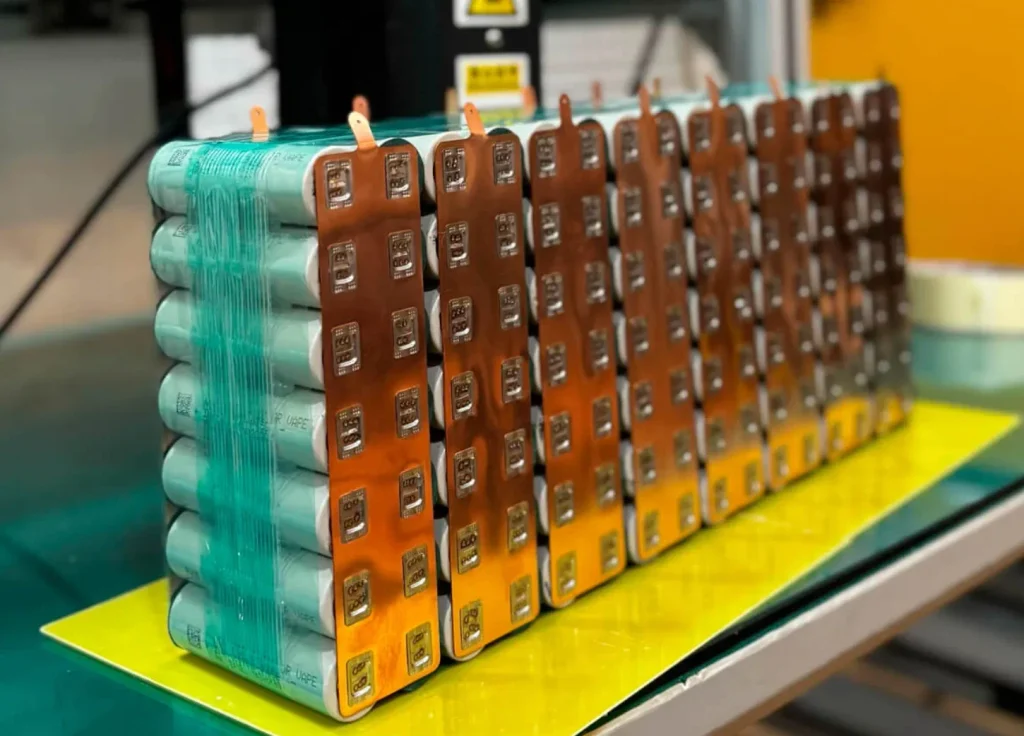
Demand for these solutions extends beyond individual local markets.
European electric scooter owners increasingly face the question of whether to replace an ageing vehicle, replace its original battery or adapt it with a battery designed for their particular requirements.
Spanish specialists such as AF SCOOTERS also work on custom battery projects for customers in other European Union countries, where non-standard configurations may be required for particular scooter models or range requirements.
These projects can involve different voltages and capacities, but the underlying process remains similar: understand the vehicle first and define the battery specification afterwards.
Extending the useful life of electric scooters
Battery degradation does not necessarily mean that an entire electric scooter has reached the end of its useful life.
In suitable cases, replacing or rebuilding the battery can restore functionality. Where the original battery remains healthy, additional capacity can sometimes extend the vehicle’s practical range.
Custom lithium batteries therefore occupy a specific role within the European micromobility aftermarket.
They are not a universal solution, and increasing capacity alone is not enough. Successful projects depend on matching battery chemistry, capacity, voltage, current capability, electronics and physical design to the characteristics of the vehicle.
AF SCOOTERS Technical Team
This article is based on the practical experience of the AF SCOOTERS technical team, including Iaroslav Tugai (Yari), who has extensive hands-on experience with electric scooters, battery systems and range-extension projects. Based in Spain, AF SCOOTERS works with electric scooter repair and custom lithium battery solutions, including internal, external and switched battery configurations for projects in Spain and other European markets.

Karen Altizer is a seasoned professional with a wealth of experience, skilled at crafting compelling narratives and strategic messages for diverse audiences.